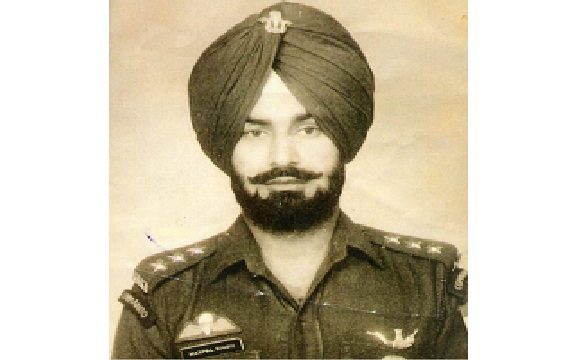
Balidan Diwas
23 June 1988
Place of Supreme Sacrifice
Sri Lanka
State of Origin
Rupnagar, Punjab
Service Number
IC-37542F
Unit / Regiment
1 Para (Special Forces)
Operation
Op Pawan (Sri Lanka)
War / Conflict
IPKF Operations (Sri Lanka)
Biography
Captain Harpal Singh hailed from Makrauna village in Chamkaur Sahib Tehsil in Rupnagar district of Punjab. Born in 1956 into a Jat Sikh family, he seemed destined for a life of valour. His father, Major Pritam Singh, was an army veteran, and the spirit of service ran deep in the family. Captain Harpal Singh began his education at the Punjab Public School (PPS), Nabha, where he was admitted in 1965. Over the next seven years he distinguished himself not only academically but also in extracurricular activities. Affectionately known as "Phoola," he was admired for his cheerful personality and was immensely popular among his peers. A natural leader and outstanding sportsman, he rose to become the School Head Boy. Inspired by his father's military legacy, Capt Harpal Singh joined the Indian Army in 1976. He was commissioned into the elite 1st Para (Special Forces) battalion of the Parachute Regiment — an infantry regiment renowned for its daring operations and exceptional para commandos. Once in service, he undertook a series of advanced military training courses and excelled in all of them, further specialising in deep sea diving. By 1988, after 12 years of committed service, Captain Harpal Singh had earned a reputation as a dedicated and fearless officer who truly embodied the spirit and honour of the Indian Army. In June 1988 he was serving with 1 Para (SF), which had been deployed in Sri Lanka as part of Operation Pawan — a major military initiative launched by India under the Indo-Sri Lanka Accord of 1987 to disarm the Liberation Tigers of Tamil Eelam (LTTE) and restore peace in the region. By mid-1988 the Indian Peace Keeping Force had conducted several intense operations against the LTTE, but the insurgency continued unabated. It was in this volatile, high-risk environment that 1 Para (SF) was assigned a critical mission on 23rd June 1988. Based on confirmed intelligence, an LTTE training camp had been identified deep within a densely forested region falling under the battalion's area of responsibility, and Captain Harpal Singh's team was chosen to lead the airborne assault. At approximately 0950 hours on the morning of 23rd June, he and his comrades approached the designated drop zone aboard an Mi-8 helicopter of 109 Helicopter Unit of the Indian Air Force. As the helicopter hovered at a low altitude — about 15 to 20 metres above the ground — the hidden LTTE militants suddenly emerged from under the jungle canopy and opened fire with automatic weapons. At that moment Captain Harpal Singh was positioned at the open rear of the helicopter, fully exposed. Without hesitation he engaged the attackers, returning fire with remarkable courage and composure, providing crucial covering fire for his team. In the process he was struck in the chest by enemy bullets. Gravely wounded, he continued to fight until he succumbed to his injuries, martyred in the line of duty. Captain Harpal Singh's actions on that fateful day exemplify the highest ideals of courage, leadership and devotion to duty. He made the ultimate sacrifice for the nation, upholding the proud legacy of the Indian Army and the elite Para Special Forces.
Sources
Information compiled from publicly available official and historical sources.
Veergati is an independent digital memorial and is not affiliated with the Government of India. Disclaimer & Sources
Remembered Alongside
Captain Arun Singh Jasrotia
9 Para (SF), The Parachute Regiment · 1995
Naik Gurpreet Singh
10 Para Commando · 1971
Paratrooper Karamjeet Singh
The Parachute Regiment (23 Para) · 2019
Lance Naik Sandeep Singh
4 Para (SF), The Parachute Regiment · 2018
Naik Sukhdev Singh
9 PARA, Parachute Regiment · 1989
Havildar Ajit Singh
10 Para (SF), The Parachute Regiment · 1989